RACP Divisional Written Exam · FRACP

Geriatrics for the written exam

Everything Physify has for Geriatrics: short lessons written to Australian guidance, exam-style questions with a worked explanation for each, and Bedside, our AI tutor, under every one. Try a question below, no sign-up.

courses
19courses
lessons
102lessons
exam-style questions
462exam-style questions
figures in the lessons
12figures in the lessons

Try one now · no sign-up

Geriatrics

A 90 year old woman in residential care with chronic constipation on oxycodone has 1 day of lower abdominal pain and fever of 38.4 degrees. WBC is 17 x 10^9/L and lactate 3.1 mmol/L. CT shows a large rectosigmoid faecaloma, colonic wall thickening, pericolonic fat stranding and a few locules of extraluminal gas beside the rectosigmoid. She has mild lower abdominal tenderness. She and her family want active treatment. What is the most appropriate management?

Pick an answer to see the explanation

What's covered

19 courses, each a set of lessons with a quiz after them. The bar shows how many questions each has. Open a course to see its lesson outline.

From the lessons

12 figures sit in the Geriatrics lessons: ECGs, diagrams, films and clinical images, each with what to look for. Here are 4. Tap one to enlarge it.
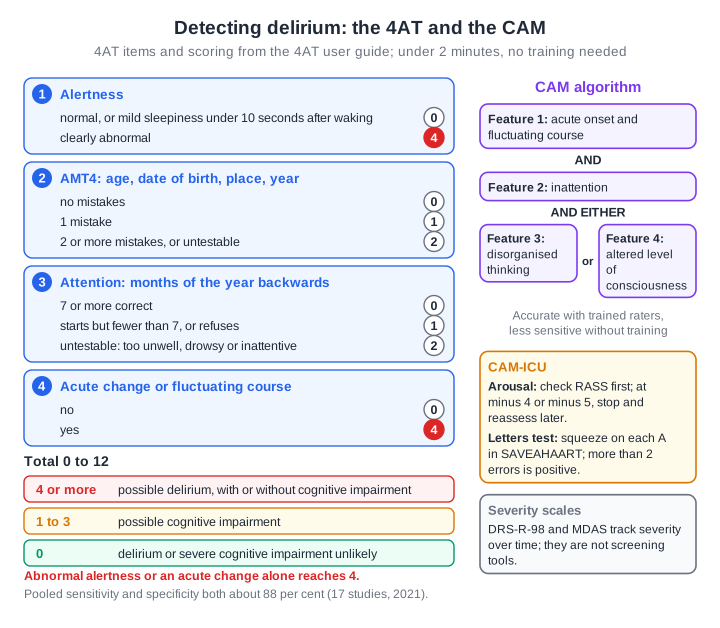
The 4AT form. Item 1, alertness: normal, or mild sleepiness for under 10 seconds after waking, scores 0; clearly abnormal scores 4. Item 2, AMT4 (age, date of birth, place, year): no mistakes 0, 1 mistake 1, 2 or more mistakes or untestable 2. Item 3, months of the year backwards: 7 or more correct 0, starts but fewer than 7 or refuses 1, untestable 2. Item 4, acute change or fluctuating course: no 0, yes 4. Total 0 to 12: 4 or more possible delirium, 1 to 3 possible cognitive impairment, 0 delirium or severe cognitive impairment unlikely; abnormal alertness or an acute change alone reaches 4; pooled sensitivity and specificity both about 88 per cent. Beside it the CAM algorithm: feature 1, acute onset and fluctuating course, and feature 2, inattention, and either feature 3, disorganised thinking, or feature 4, altered level of consciousness; accurate with trained raters. CAM-ICU: check RASS first and stop at minus 4 or minus 5; the letters test with SAVEAHAART is positive with more than 2 errors. DRS-R-98 and MDAS track severity and are not screening tools.
Physify teaching diagram; 4AT items and scoring as in the 4AT user guide. Original. Tap the image to zoom.

From the lesson “Delirium: Detection, Diagnosis and Investigation” in Delirium
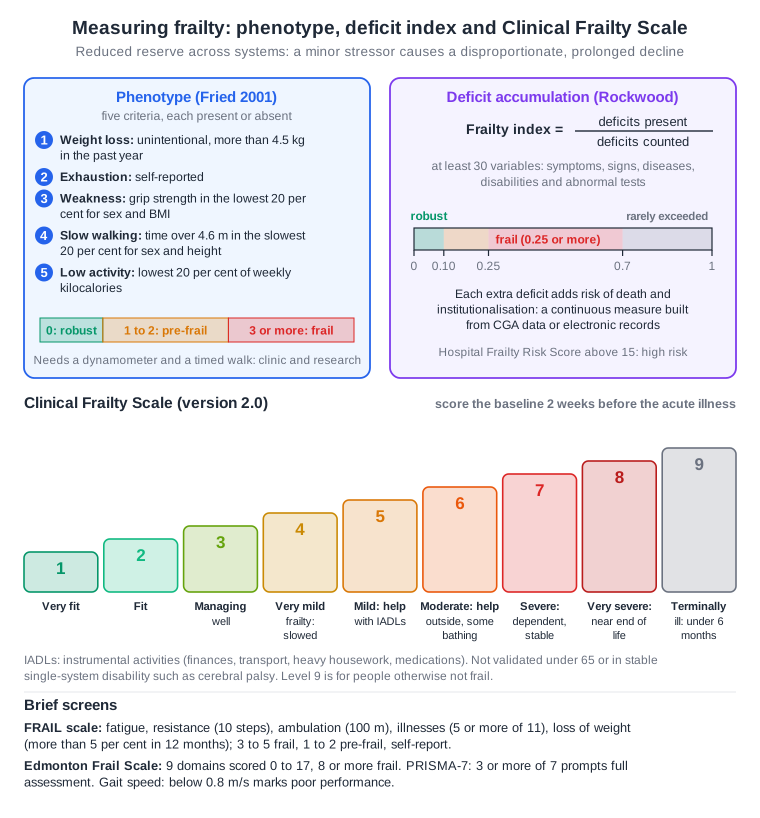
Three ways to measure frailty. The Fried phenotype has five criteria: unintentional weight loss of more than 4.5 kg in a year, self-reported exhaustion, grip strength in the lowest 20 per cent for sex and BMI, time over 4.6 m in the slowest 20 per cent for sex and height, and the lowest 20 per cent of weekly kilocalories; 0 is robust, 1 to 2 pre-frail, 3 or more frail; it needs a dynamometer and a timed walk. The Rockwood frailty index is deficits present divided by deficits counted, from at least 30 variables, drawn on a 0 to 1 scale: below about 0.10 robust, 0.25 or more frail, and about 0.7 rarely exceeded; each deficit adds risk, and a Hospital Frailty Risk Score above 15 marks high risk. The Clinical Frailty Scale is drawn as nine rising steps: 1 very fit, 2 fit, 3 managing well, 4 very mild frailty, 5 mild frailty needing help with instrumental activities, 6 moderate frailty needing help outside and with some bathing, 7 severe frailty, dependent but stable, 8 very severe, near the end of life, and 9 terminally ill with life expectancy under 6 months; the baseline 2 weeks before the illness is scored, and it is not validated under 65 or in stable single-system disability. Brief screens: the FRAIL scale (3 to 5 frail, 1 to 2 pre-frail), the Edmonton Frail Scale (0 to 17, 8 or more frail), PRISMA-7 (3 or more of 7) and gait speed below 0.8 m/s.
Physify teaching diagram (schematic). Tap the image to zoom.

From the lesson “Frailty: Definitions, Models and Screening Tools” in Frailty
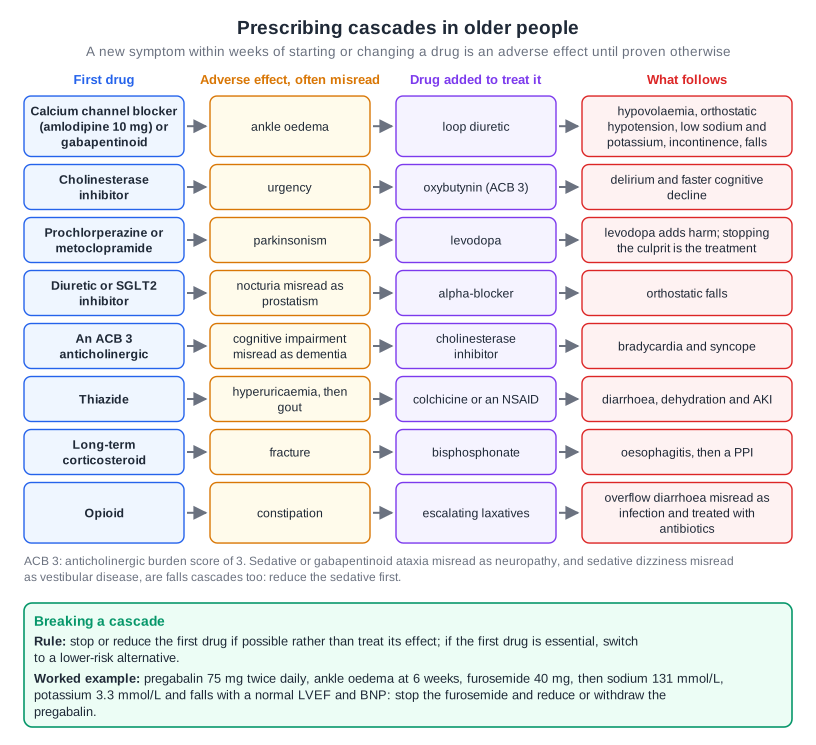
Eight prescribing cascades drawn as chains of first drug, adverse effect, drug added and what follows: a calcium channel blocker (amlodipine 10 mg) or gabapentinoid causes ankle oedema, a loop diuretic is added, and hypovolaemia, orthostatic hypotension, low sodium and potassium, incontinence and falls follow; a cholinesterase inhibitor causes urgency, oxybutynin (ACB 3) is added, then delirium and faster cognitive decline; prochlorperazine or metoclopramide causes parkinsonism and levodopa is added, when stopping the culprit is the treatment; a diuretic or SGLT2 inhibitor causes nocturia misread as prostatism, an alpha-blocker is added, then orthostatic falls; an ACB 3 anticholinergic causes cognitive impairment misread as dementia, a cholinesterase inhibitor is added, then bradycardia and syncope; a thiazide causes hyperuricaemia and gout, colchicine or an NSAID is added, then diarrhoea, dehydration and AKI; a long-term corticosteroid causes fracture, a bisphosphonate is added, then oesophagitis and a PPI; an opioid causes constipation, laxatives escalate, then overflow diarrhoea is misread as infection and treated with antibiotics. Sedative ataxia and dizziness misread as neuropathy or vestibular disease are falls cascades too. Breaking a cascade: stop or reduce the first drug rather than treat its effect, or switch to a lower-risk alternative; worked example, pregabalin 75 mg twice daily, ankle oedema at 6 weeks, furosemide 40 mg, then sodium 131 mmol/L, potassium 3.3 mmol/L and falls with a normal LVEF and BNP: stop the furosemide and reduce or withdraw the pregabalin.
Physify teaching diagram (schematic). Tap the image to zoom.

From the lesson “Prescribing Cascades in Older People” in Polypharmacy
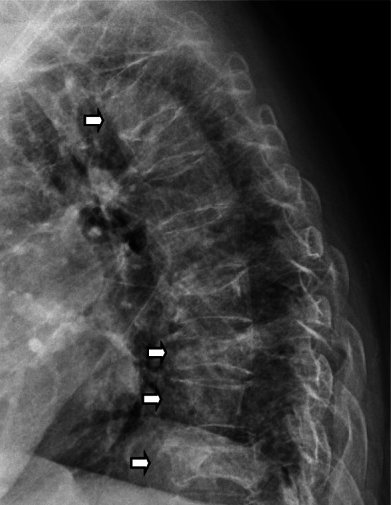
Lateral radiograph of the thoracic spine. White arrows mark several vertebral bodies in the upper and lower thoracic spine that are shorter than their neighbours, more so at the front.
Multiple thoracic vertebral fractures on a lateral radiograph: anterior wedging and loss of height at several levels. Each is a minimal trauma fracture, which diagnoses osteoporosis whatever the T-score and predicts the next fracture. Image: Maugars et al., J Med Case Rep 2020 (figure 2, upper right panel), CC BY 4.0, via PubMed Central; cropped. Original. Tap the image to zoom.

From the lesson “Fragility Fractures: Definition, Imminent Risk and Assessment” in Osteoporosis and Fragility Fractures in Older People

Free for Geriatrics

Geriatrics in the clinical exam

2 long cases for the RACP Divisional Clinical Exam: you examine, present and are marked on the five RACP domains.

See the clinical exam →

Open all of Geriatrics

A membership opens every lesson and all 462 Geriatrics questions, with the rest of the bank (11,500+ questions across 17 specialties), 15 timed mock exams, smart review and a daily plan to your exam.

The trial needs a card; cancel any time before it ends and you pay nothing. The free account needs no card.

Other specialties

Physify is a study aid for exam preparation only. It is not medical advice and must not be used to guide the care of any patient. Terms