RACP Divisional Written Exam · FRACP

Pharmacology, Toxicology & Addiction for the written exam

Everything Physify has for Pharmacology, Toxicology & Addiction: short lessons written to Australian guidance, exam-style questions with a worked explanation for each, and Bedside, our AI tutor, under every one. Try a question below, no sign-up.

courses
13courses
lessons
62lessons
exam-style questions
299exam-style questions
figures in the lessons
12figures in the lessons

Try one now · no sign-up

Pharmacology, Toxicology & Addiction

A 59 year old woman with Child-Pugh B cirrhosis and large oesophageal varices is given oral morphine 10 mg for rib pain and 1 hour later is unrousable with a respiratory rate of 8. Her eGFR is 84 mL/min/1.73 m2, albumin 31 g/L, and she takes no other sedative drugs. What best explains this?

Pick an answer to see the explanation

What's covered

13 courses, each a set of lessons with a quiz after them. The bar shows how many questions each has. Open a course to see its lesson outline.

From the lessons

12 figures sit in the Pharmacology, Toxicology & Addiction lessons: ECGs, diagrams, films and clinical images, each with what to look for. Here are 4. Tap one to enlarge it.
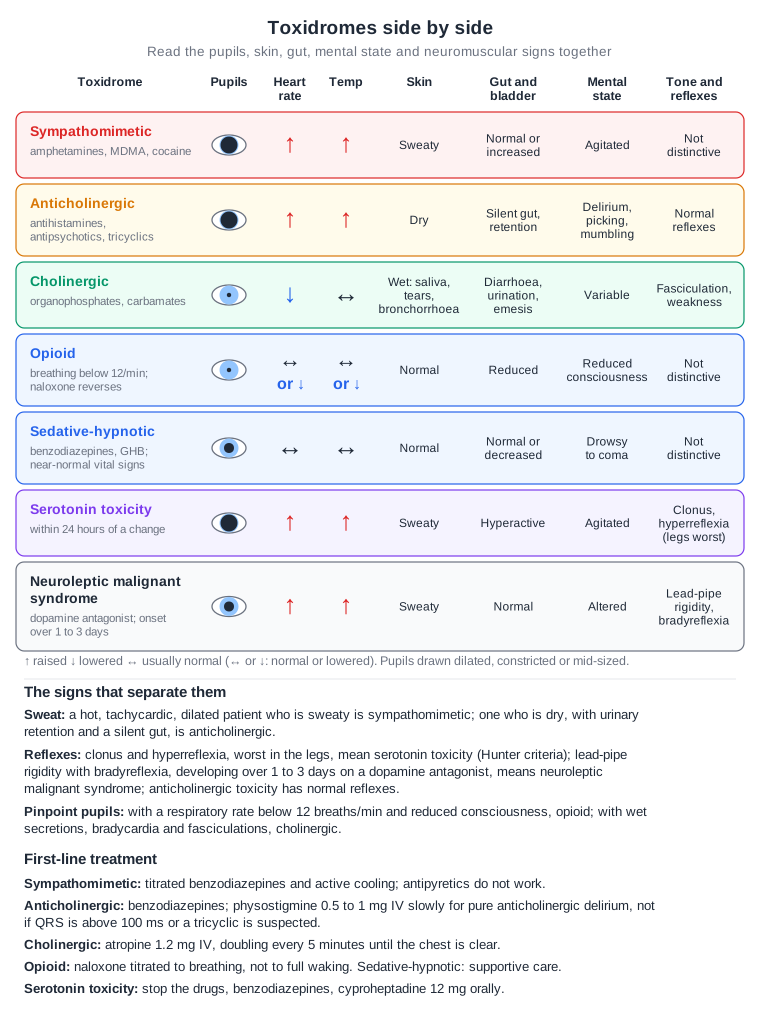
A table of toxidromes with columns for pupils (drawn to size), heart rate, temperature, skin, gut and bladder, mental state, and tone and reflexes. Sympathomimetic (amphetamines, MDMA, cocaine): dilated pupils, raised heart rate and temperature, sweaty skin, gut normal or increased, agitated, tone and reflexes not distinctive. Anticholinergic (antihistamines, antipsychotics, tricyclics): dilated pupils, raised heart rate and temperature, dry skin, silent gut and urinary retention, delirium with picking and mumbling, normal reflexes. Cholinergic (organophosphates, carbamates): pinpoint pupils, lowered heart rate, usually normal temperature, wet with saliva, tears and bronchorrhoea, diarrhoea, urination and emesis, variable mental state, fasciculation and weakness. Opioid (breathing below 12 a minute; naloxone reverses): pinpoint pupils, heart rate and temperature normal or lowered, normal skin, reduced gut activity, reduced consciousness, tone and reflexes not distinctive. Sedative-hypnotic (benzodiazepines, GHB; near-normal vital signs): mid-sized pupils, usually normal heart rate and temperature, normal skin, gut normal or decreased, drowsy to coma, tone and reflexes not distinctive. Serotonin toxicity (within 24 hours of a change): dilated pupils, raised heart rate and temperature, sweaty skin, hyperactive gut, agitated, clonus and hyperreflexia worst in the legs. Neuroleptic malignant syndrome (dopamine antagonist, onset over 1 to 3 days): mid-sized pupils, raised heart rate and temperature, sweaty skin, normal gut, altered mental state, lead-pipe rigidity and bradyreflexia. Notes give the separating signs (sweat separates sympathomimetic from anticholinergic, which is dry with urinary retention and a silent gut; clonus and hyperreflexia mean serotonin toxicity, rigidity with bradyreflexia over 1 to 3 days on a dopamine antagonist means neuroleptic malignant syndrome, and anticholinergic toxicity has normal reflexes; pinpoint pupils with breathing below 12 a minute and reduced consciousness mean opioid, and with wet secretions, bradycardia and fasciculations cholinergic) and first-line treatment: titrated benzodiazepines and active cooling for sympathomimetic toxicity, as antipyretics do not work; benzodiazepines, or physostigmine 0.5 to 1 mg IV slowly for pure anticholinergic delirium, not if QRS is above 100 ms or a tricyclic is suspected; atropine 1.2 mg IV, doubling every 5 minutes until the chest is clear, for cholinergic toxicity; naloxone titrated to breathing, not to full waking; supportive care for sedative-hypnotics; and stopping the drugs, benzodiazepines and cyproheptadine 12 mg orally for serotonin toxicity.
Physify teaching diagram (schematic). Tap the image to zoom.

From the lesson “Toxidromes and Serotonin Toxicity” in The Poisoned Patient & Toxidromes
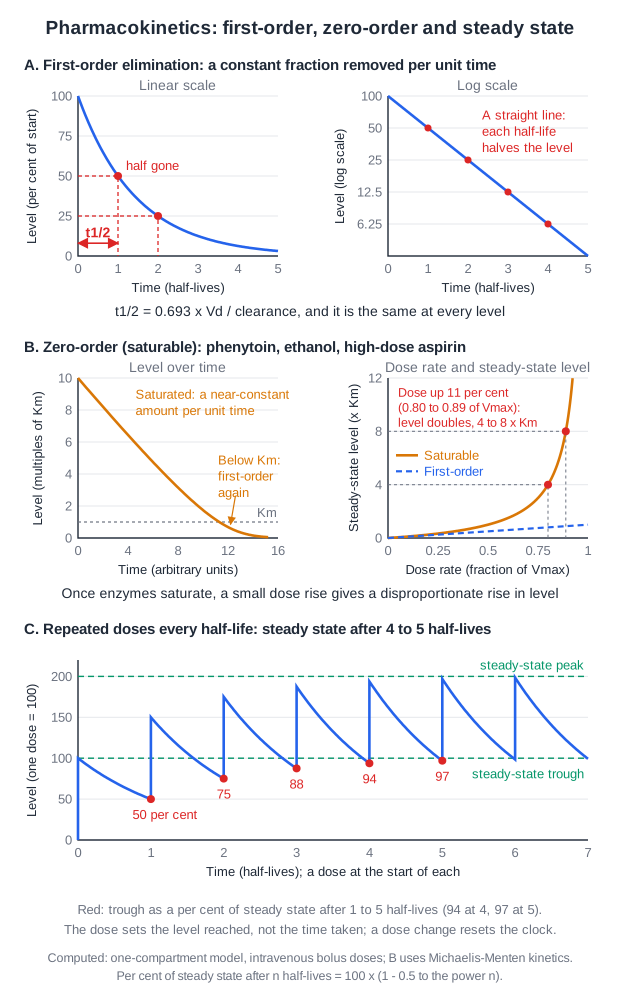
Three panels. A: first-order elimination, with the level halving every half-life (100, 50 and 25 per cent at 0, 1 and 2 half-lives) on a linear scale, and the same fall as a straight line on a log scale. B: zero-order, saturable elimination, as for phenytoin, ethanol and high-dose aspirin: the level falls by a near-constant amount per unit time until it drops below Km, then becomes first-order; beside it, the steady-state level rises in proportion to dose rate for a first-order drug but climbs steeply for a saturable drug, where raising the dose rate from 0.80 to 0.89 of Vmax doubles the level from 4 to 8 times Km. C: doses given every half-life accumulate, with troughs at 50, 75, 88, 94 and 97 per cent of steady state after 1 to 5 half-lives, and a steady-state peak twice the single-dose level.
Physify teaching diagram. Tap the image to zoom.

From the lesson “Clearance, Half-life and Dose Calculation” in Clinical Pharmacokinetics & Pharmacodynamics
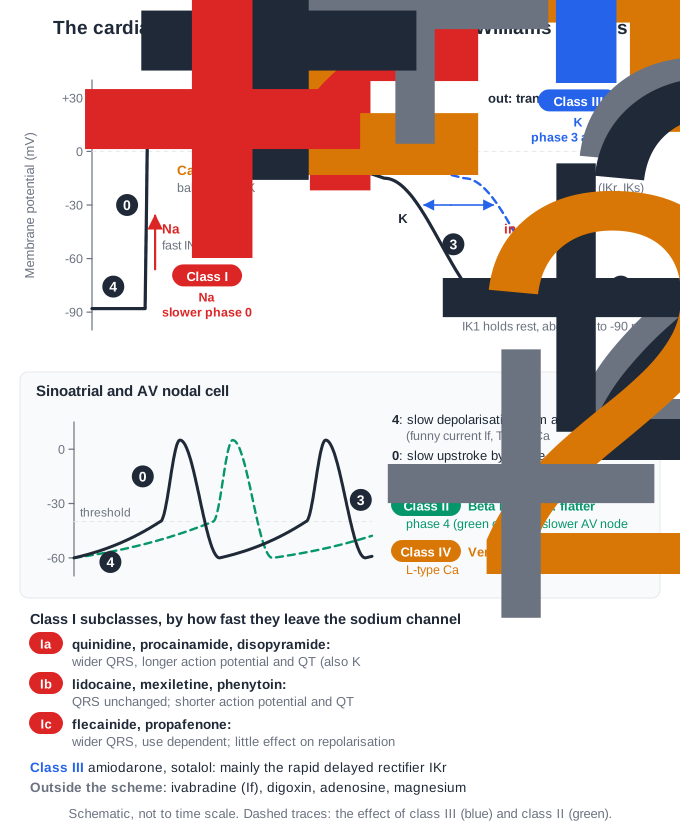
Schematic ventricular myocyte action potential, membrane potential in mV against time. Phase 4: the inward rectifier IK1 holds a stable resting potential of about minus 85 to minus 90 mV. Phase 0: rapid upstroke from fast sodium entry (INa); class I drugs block the sodium channel and slow phase 0. Phase 1: a brief notch from the transient outward potassium current Ito. Phase 2: the plateau, with L-type calcium entry balanced by potassium exit through IKr and IKs. Phase 3: repolarisation by potassium exit through IKr and IKs, then IK1; class III drugs block potassium channels, and a dashed trace shows the longer phase 3 and so the longer QT. A second panel shows a sinoatrial or atrioventricular nodal cell: slow phase 4 depolarisation from about minus 60 mV (funny current If and T-type calcium) to threshold, a slow phase 0 upstroke carried by L-type calcium, and phase 3 repolarisation by potassium exit. Class II beta blockers flatten phase 4 (a dashed trace reaches threshold later) and slow the atrioventricular node; class IV verapamil and diltiazem block the L-type calcium channel and slow the nodal upstroke. A key lists the class I subclasses: Ia (quinidine, procainamide, disopyramide) widen the QRS and prolong the action potential and QT, with additional potassium channel block; Ib (lidocaine, mexiletine, phenytoin) leave the QRS unchanged and shorten the action potential and QT; Ic (flecainide, propafenone) widen the QRS with use dependence and have little effect on repolarisation. Class III amiodarone and sotalol act mainly on the rapid delayed rectifier IKr. Outside the scheme: ivabradine (If), digoxin, adenosine and magnesium.
Physify teaching diagram (schematic). Tap the image to zoom.

From the lesson “Antiarrhythmics and Rate-Controlling Agents” in Cardiovascular Pharmacology
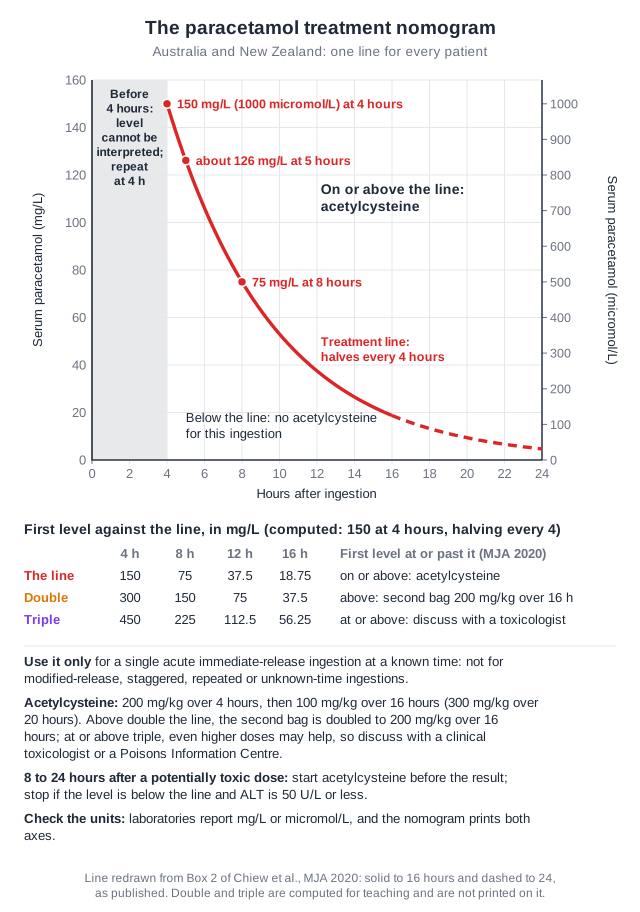
The Australian and New Zealand paracetamol treatment nomogram: serum paracetamol on the left axis in mg/L (0 to 160) and on the right in micromol/L (0 to 1000), against hours after ingestion (0 to 24). The first 4 hours are shaded: a level taken then cannot be interpreted and is repeated at 4 hours. One treatment line starts at 150 mg/L (1000 micromol/L) at 4 hours and halves every 4 hours, passing about 126 mg/L at 5 hours and 75 mg/L at 8 hours; it is solid to 16 hours and dashed to 24 hours, as published. On or above the line: acetylcysteine. Below the line: no acetylcysteine for this ingestion. A table computed from the line gives the line, double and triple at 4, 8, 12 and 16 hours: 150, 75, 37.5 and 18.75; 300, 150, 75 and 37.5; 450, 225, 112.5 and 56.25 mg/L. On or above the line means acetylcysteine; a first level above double the line means the second bag is doubled to 200 mg/kg over 16 hours; at or above triple, even higher doses may help, so discuss with a clinical toxicologist or a Poisons Information Centre. Notes say the nomogram is only for a single acute immediate-release ingestion at a known time, not for modified-release, staggered, repeated or unknown-time ingestions; acetylcysteine is 200 mg/kg over 4 hours then 100 mg/kg over 16 hours (300 mg/kg over 20 hours); 8 to 24 hours after a potentially toxic dose acetylcysteine is started before the result and stopped if the level is below the line and ALT is 50 U/L or less; and laboratories report mg/L or micromol/L, so check the units.
Physify teaching diagram: the treatment line redrawn from Box 2 of Chiew et al., MJA 2020; double and triple the line are computed for teaching and are not printed on the nomogram. Original. Tap the image to zoom.

From the lesson “Toxicity, Risk Assessment and the Nomogram” in Paracetamol Poisoning

Free for Pharmacology, Toxicology & Addiction

Pharmacology, Toxicology & Addiction in the clinical exam

1 long case for the RACP Divisional Clinical Exam: you examine, present and are marked on the five RACP domains.

See the clinical exam →

Open all of Pharmacology, Toxicology & Addiction

A membership opens every lesson and all 299 Pharmacology, Toxicology & Addiction questions, with the rest of the bank (11,500+ questions across 17 specialties), 15 timed mock exams, smart review and a daily plan to your exam.

The trial needs a card; cancel any time before it ends and you pay nothing. The free account needs no card.

Other specialties

Physify is a study aid for exam preparation only. It is not medical advice and must not be used to guide the care of any patient. Terms